
Hourly vs Fixed Price Website Development: Which Is Better for Your Project?
Confused between hourly and fixed-price website development? Compare costs, benefits, drawbacks, and learn which pricing model is right for your project.
When planning a website development project, one of the first decisions you’ll need to make is how you want to pay your developer.
Some developers charge by the hour, while others offer a fixed price for the entire project. Both pricing models are widely used, and neither is automatically better than the other.
The right choice depends on your project requirements, budget, timeline, and how clearly you can define the work before development begins.
In this guide, we’ll explain both pricing models, compare their advantages and disadvantages, and help you decide which option makes the most sense for your website development project.
The short answer
If you already know exactly what you want to build, fixed-price website development is usually the better choice. You agree on the scope, deliverables, timeline, and total cost before development starts.
However, if your project requirements are likely to change, or you’re building something that needs continuous improvements, hourly website development may be more suitable.
Here’s a simple way to decide:
- Choose hourly pricing: For ongoing development, troubleshooting, maintenance, experiments, and projects with changing requirements.
- Choose fixed pricing: For business websites, landing pages, portfolio websites, and projects with clearly defined requirements.
- Choose a hybrid model: When you need a fixed budget for the main project but want flexibility for additional features.
Let’s understand how each model works.
What is hourly website development?
Hourly website development is a pricing model in which you pay a developer for the actual time spent working on your project.
For example, suppose a WordPress developer charges ₹1,000 per hour. If they work for 20 hours on your website, your development cost will be ₹20,000.
The final amount depends on the total working hours.
This model is commonly used for:
- WordPress website modifications.
- Custom plugin development.
- Bug fixing and troubleshooting.
- Website speed optimization.
- Adding new features to existing websites.
- Ongoing website maintenance.
- Long-term development support.
Example of hourly pricing
Suppose you want to add a custom booking system to your existing WordPress website.
The developer estimates that the work may take 15–25 hours, but the exact time depends on the existing website structure and technical requirements.
| Particulars | Details |
|---|---|
| Developer hourly rate | ₹1,000 |
| Estimated working hours | 20 hours |
| Estimated total cost | ₹20,000 |
If the developer completes the work in 15 hours, you pay ₹15,000. If it takes 25 hours, you pay ₹25,000.
The advantage is flexibility, but the final cost may not be known until the work is completed.
What is fixed-price website development?
Fixed-price website development is a pricing model in which you agree on the total project cost before development begins.
The developer first understands your requirements, prepares a project scope, estimates the development effort, and provides a final quotation.
Once both parties agree, the project is completed for the agreed price, provided the requirements remain within the original scope.
For example, suppose you want a business website with:
- 8 website pages.
- Custom homepage design.
- Contact form integration.
- Mobile-responsive design.
- Basic on-page SEO.
- WhatsApp integration.
The developer provides a fixed quotation of ₹50,000.
Whether the developer completes the project in 40 hours or 55 hours, your agreed project cost remains ₹50,000, assuming there are no additional requirements.
Example of fixed-price development
| Particulars | Details |
|---|---|
| Project | Business website |
| Agreed project price | ₹50,000 |
| Estimated timeline | 20 working days |
| Agreed deliverables | 8 pages and listed features |
| Final development cost | ₹50,000 |
This pricing model gives clients better budget predictability and makes project planning easier.
However, additional features or changes outside the agreed scope may require a separate quotation.
Hourly vs fixed price: Key differences
Both pricing models have their own advantages. Here’s how they compare across important factors.
| Comparison | Hourly Pricing | Fixed Pricing |
|---|---|---|
| Payment method | Per working hour | Per project |
| Budget predictability | Lower | Higher |
| Flexibility | High | Limited to agreed scope |
| Project requirements | Can evolve | Should be clearly defined |
| Cost estimation | Based on estimated hours | Agreed upfront |
| Scope changes | Usually easier to accommodate | May require additional charges |
| Best for | Ongoing development | Defined projects |
| Client involvement | Regular time and progress tracking | Scope and milestone reviews |
| Risk of cost overruns | Higher for clients | Higher for developers if underestimated |
Important: Fixed pricing doesn’t mean unlimited revisions or additional features. Similarly, hourly pricing doesn’t mean developers should work without providing estimates or progress reports.
Clear communication and a written agreement are important under both models.
Advantages and disadvantages of hourly pricing
Hourly pricing is a good option when flexibility is more important than having a fixed total budget.
Advantages
1. Greater flexibility
You can change requirements, add new features, or adjust existing functionality without renegotiating the entire project price.
2. Suitable for ongoing development
If you regularly need website improvements, bug fixes, or technical support, paying for actual working hours can be practical.
3. Ideal for uncertain projects
Sometimes you don’t know exactly how much development work will be required. Hourly pricing allows developers to investigate and solve problems without committing to an unrealistic fixed quotation.
4. Transparent work tracking
You can ask your developer to provide timesheets or task-wise reports showing how much time was spent on different activities.
Disadvantages
1. Final cost is uncertain
Your estimated budget may increase if development takes longer than expected.
2. Requires regular monitoring
Clients may need to review work reports, completed tasks, and working hours to understand where their money is going.
3. Inefficient development can become expensive
If a developer takes longer than necessary to complete a task, your overall cost increases.
4. Difficult to plan large budgets
When the project involves multiple features and uncertain requirements, estimating the final expense can be challenging.
Advantages and disadvantages of fixed pricing
Fixed pricing is generally preferred by clients who want to know their development budget before starting a project.
Advantages
1. Budget clarity
You know the agreed development cost before the project begins, making financial planning easier.
2. Clear project expectations
The project scope, deliverables, timeline, and payment terms can be documented in advance.
3. Less time spent tracking hours
You don’t need to monitor every development hour. Instead, you can focus on milestones and completed deliverables.
4. Suitable for business websites
If you need a company website, portfolio website, landing page, or standard WooCommerce store with clearly defined requirements, fixed pricing is often a practical option.
Disadvantages
1. Changes can increase the cost
If you request additional functionality after development begins, the developer may charge extra.
2. Requires detailed planning
Both parties must understand the requirements before agreeing on the price.
3. Difficult for projects with uncertain requirements
If you’re still experimenting with features or changing your business idea, a fixed-price agreement may become difficult to manage.
4. Poorly defined scope can create disputes
If the agreement doesn’t clearly explain what is included, clients and developers may have different expectations about the final deliverables.
When should you choose hourly pricing?
Hourly pricing is a better option in situations where the development work cannot be accurately defined in advance.
Consider hourly pricing if:
- You already have a website and need regular modifications.
- You want to hire a developer for ongoing WordPress support.
- You need custom plugin development with evolving requirements.
- You’re working on a new product and want to experiment with different features.
- You need technical troubleshooting or bug fixing.
- You’re looking for a dedicated developer to work with your internal team.
Example:
Suppose you operate a WooCommerce store and want to introduce new features every month.
In January, you need product filter improvements. In February, you want a custom checkout experience. In March, you need a new shipping integration.
Instead of preparing a separate fixed-price agreement for every small task, hiring a developer on an hourly basis may be more convenient.
When should you choose fixed pricing?
Fixed pricing is a better option when you can explain exactly what needs to be developed.
Consider fixed pricing if:
- You want to build a new business website.
- You need a landing page for a marketing campaign.
- You want a portfolio website.
- You have an approved website design in Figma.
- You need a defined WooCommerce store.
- You have a clear list of features and expected deliverables.
- You have a limited project budget.
Example:
Suppose you’re starting a new business and need a professional WordPress website with 6 pages, a contact form, WhatsApp integration, and basic SEO.
You already know what you want, so a developer can prepare a detailed quotation and agree on a final price.
In this situation, fixed-price development is usually the more convenient option.
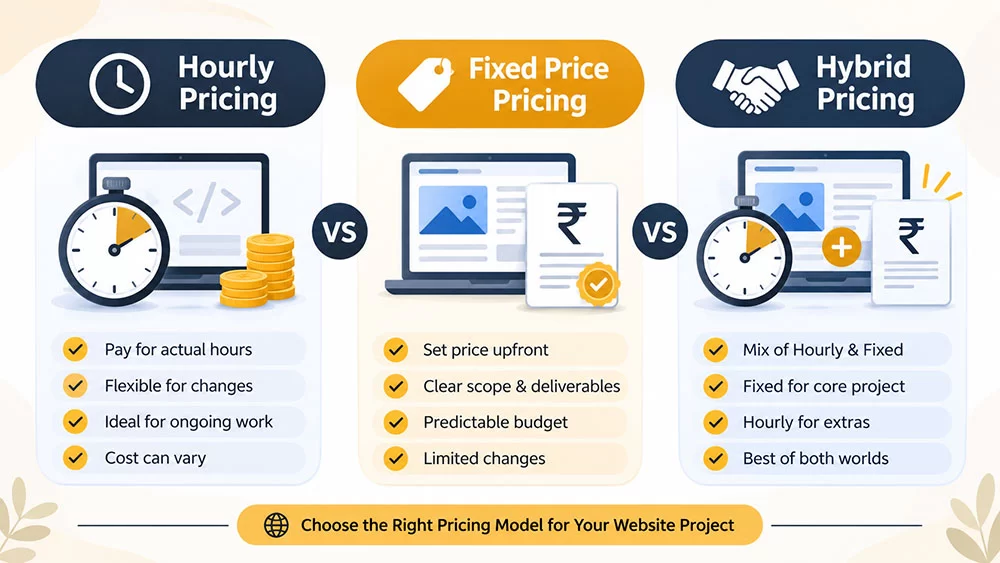
Can you combine hourly and fixed pricing?
Yes. You don’t always have to choose only one pricing model.
Many website development projects benefit from a hybrid pricing approach, where different stages of development use different payment structures.
For example:
Phase 1: Planning and requirement analysis
The developer can charge hourly for research, technical investigation, and requirement discovery.
Phase 2: Main website development
Once the requirements are finalized, the developer provides a fixed quotation for the agreed deliverables.
Phase 3: Additional features
If you want new functionality that wasn’t included in the original agreement, the developer can charge hourly or provide a separate fixed quotation.
Phase 4: Maintenance and support
After the website goes live, you can hire the developer on an hourly or monthly support arrangement.
This approach provides budget clarity for the main project while keeping flexibility for future improvements.
How to choose the right pricing model
Before hiring a website developer, ask yourself these five questions.
1. Are your requirements clearly defined?
If you have a detailed list of pages, features, integrations, and design expectations, fixed pricing is a good option.
If you’re still deciding what to build, hourly pricing may be more suitable.
2. Do you have a fixed budget?
If you have a specific budget and need to avoid unexpected development expenses, fixed pricing provides better cost predictability.
3. Will your requirements change frequently?
If you expect regular changes, new features, and ongoing improvements, hourly pricing offers greater flexibility.
4. Is this a one-time project or ongoing work?
For a one-time website development project, fixed pricing is often practical.
For continuous development and technical support, hourly pricing may be more convenient.
5. How much involvement do you want in the development process?
If you want regular discussions, experiments, and changes during development, hourly engagement may work better.
If you prefer agreeing on deliverables and reviewing progress at milestones, fixed pricing may be more suitable.
Tips to avoid pricing disputes
Regardless of the pricing model you choose, a few precautions can help you avoid unnecessary misunderstandings.
- Prepare a clear requirement document: List all website pages, features, integrations, and expected functionality before development begins.
- Define project scope: Clearly mention what is included and excluded from the quotation.
- Agree on a timeline: Discuss delivery dates, milestones, and dependencies.
- Set revision limits: Define how many design or content revisions are included.
- Clarify additional charges: Decide how new requirements and out-of-scope work will be billed.
- Discuss payment terms: For fixed-price projects, agree on advance payments and milestone-based payments. For hourly projects, agree on billing frequency and reporting.
- Clarify post-launch support: Confirm whether bug fixes, maintenance, hosting, and future updates are included or charged separately.
A written agreement protects both the client and the developer.
Frequently asked questions
Neither pricing model is universally better. Fixed pricing is generally suitable for projects with clearly defined requirements, while hourly pricing is better for ongoing development, troubleshooting, and projects where requirements may change.
Not necessarily. A developer may charge a higher fixed amount to account for project risks and unexpected work. However, fixed pricing gives clients better budget predictability. The actual cost depends on project complexity, developer experience, and scope.
Yes, but additional requirements may involve extra charges. Before development begins, agree on how scope changes will be estimated, approved, and billed.
Developers generally consider their experience, technical skills, project complexity, overhead costs, and the type of work involved when setting hourly rates.
For a new WordPress business website with clearly defined requirements, fixed pricing is often suitable. For custom plugin development, troubleshooting, ongoing improvements, and maintenance, hourly pricing can be more practical.
Yes. Many developers offer monthly dedicated development or support arrangements. This is useful for businesses that need regular development work without hiring a full-time employee.
A good quotation should include project scope, design requirements, number of pages, functionality, integrations, development timeline, payment milestones, revision policy, exclusions, and post-launch support terms.
Choosing between hourly and fixed-price development is only the first step. Finding a developer who understands your requirements, communicates clearly, and delivers quality work is equally important. At Webcasata, we provide website development solutions for businesses, entrepreneurs, and agencies. Whether you need a complete WordPress website, custom WooCommerce development, or ongoing technical support, we can help you choose an engagement model that fits your project.